
Jan 21 2026
/
Inside India’s Largest 86 MN Extrusion Press: Engineering Wider, Stronger Aluminium Profiles
Introduction: Redefining Aluminium Extrusion at Industrial Scale
The global aluminium extrusion industry is undergoing a structural transformation. As infrastructure projects grow larger, transportation systems become more advanced, renewable energy installations scale rapidly, and industrial machinery demands higher load capacity, the need for wider, stronger, and more complex aluminium profiles has increased dramatically.
At the centre of this transformation stands a powerful technological milestone, India’s largest 86 MN aluminium extrusion press.
This high-capacity extrusion press represents more than just scale. It represents engineering precision, structural capability, global competitiveness, and future-ready manufacturing. With the ability to manufacture ultra-wide and heavy-duty aluminium profiles, the 86 MN press is redefining how aluminium extrusion supports infrastructure, industrial, and export markets.
At National Industries, the installation of the 86 MN extrusion press marks a defining chapter in India’s aluminium extrusion evolution, enabling production of profiles up to 600 mm width with high structural integrity and dimensional accuracy.
Explore advanced extrusion capabilities at
www.nationalindustries.world
Understanding What an 86 MN Extrusion Press Means
What Does 86 MN Represent?
MN stands for Mega Newton, a unit of force. An 86 MN extrusion press delivers an enormous 86 million newtons of pressure during the extrusion process.
This level of force allows the press to:
- Extrude extremely wide aluminium profiles
- Produce thicker wall sections
- Manufacture complex hollow structural shapes
- Handle high-strength aluminium alloys
- Maintain consistent metal flow across large cross-sections
In simple terms, higher press capacity equals greater engineering freedom.
Why Press Capacity Matters in 2026
In modern manufacturing, press size directly influences:
- Maximum profile width
- Structural strength capability
- Load-bearing applications
- Industrial scalability
- Project feasibility
With the rise of aluminium formwork systems, heavy-duty structural components, railway and metro infrastructure, solar mounting frameworks, and industrial platforms, high-tonnage presses like 86 MN are no longer optional. They are strategic assets.
The Engineering Behind the 86 MN Extrusion Press
Heavy-Duty Hydraulic System
An 86 MN extrusion press requires a highly engineered hydraulic system capable of delivering stable, controlled pressure at massive force levels.
Key components include:
- High-pressure hydraulic cylinders
- Precision ram control
- Advanced pressure regulation systems
- Energy-efficient hydraulic pumps
Maintaining uniform pressure ensures:
- Balanced metal flow
- Reduced internal stress
- Minimal surface defects
- Dimensional consistency
Advanced Container and Die Alignment
At this scale, even minor misalignment can cause significant profile defects. Therefore, the press integrates:
- Automated container alignment systems
- Precision die positioning mechanisms
- Intelligent pressure monitoring
This ensures uniform extrusion performance, especially for wide aluminium profiles.
Smart Automation and Digital Controls
Modern 86 MN presses integrate:
- PLC-controlled systems
- Real-time temperature monitoring
- Billet heating optimization
- Metal flow data analysis
- Predictive maintenance alerts
Automation reduces variability and enhances repeatability, which is critical for export-oriented aluminium extrusion manufacturing.
Engineering Wider Aluminium Profiles Up to 600 mm
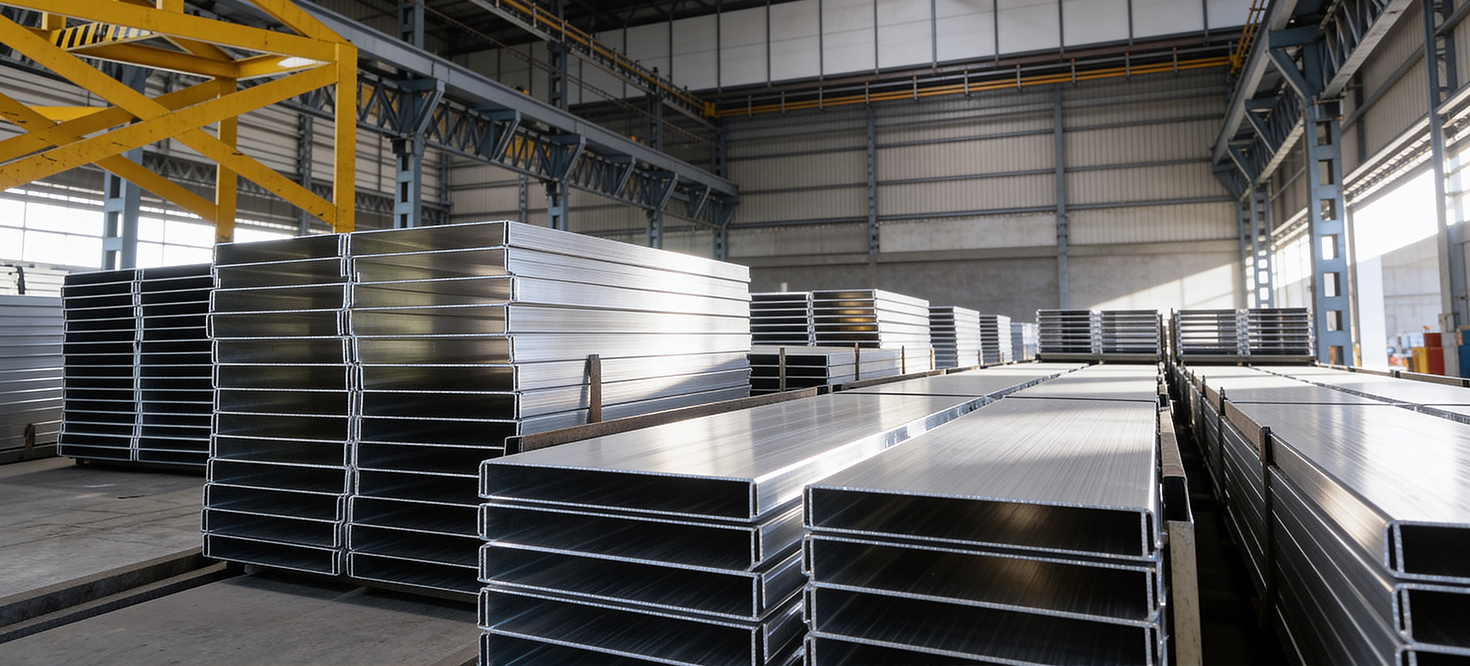
One of the most significant capabilities of an 86 MN press is the production of extra-wide aluminium profiles.
Why Wider Profiles Are Transforming Infrastructure
Wider aluminium extrusions enable:
- Jointless aluminium formwork panels
- High load-bearing industrial platforms
- Large façade structural members
- Heavy-duty solar mounting rails
- Bridge decking components
Benefits include:
- Reduced assembly points
- Improved structural rigidity
- Faster installation
- Lower maintenance requirements
- Enhanced durability
At National Industries, the 86 MN press enables production of hollow profiles up to 550 mm and solid profiles up to 600 mm width, positioning the company as a leader in large-profile extrusion manufacturing.
Strength, Stability, and Structural Integrity
Producing Stronger Aluminium Profiles
An 86 MN press enables extrusion of:
- Thick-walled structural sections
- High-strength 6000 series alloys
- Complex multi-void profiles
- Reinforced load-bearing systems
Higher pressure ensures proper metal flow even in thick cross-sections, reducing:
- Porosity
- Flow lines
- Internal weaknesses
Applications Requiring High Structural Strength
Industries that benefit include:
- Aluminium formwork manufacturing
- Metro rail infrastructure
- Industrial machinery frames
- EV battery enclosures
- Renewable energy installations
- Defence and aerospace components
The ability to engineer stronger aluminium profiles enhances performance and reliability across these sectors.
How the 86 MN Press Supports Modern Aluminium Formwork Systems
Aluminium formwork is one of the fastest-growing applications in India and global construction markets.
Large construction projects demand:
- Reusable panels
- High load capacity
- Dimensional accuracy
- Long service life
The 86 MN press allows production of:
- Wide panel sections
- Integrated rib designs
- Reduced welding requirements
- Structural reinforcement in a single extrusion
This reduces fabrication time and increases overall productivity at construction sites.
National Industries leverages this capability to serve infrastructure developers seeking high-performance aluminium formwork systems.
Integration with Billet Casting and Alloy Control
A high-capacity extrusion press alone is not enough. Quality begins at billet casting.
Metallurgical Precision
To maximize performance, billets must offer:
- Uniform grain structure
- Precise alloy composition
- Low impurity levels
- Homogenized microstructure
Integrated billet casting facilities ensure consistent feedstock quality, enabling the 86 MN press to operate at full potential.
National Industries’ integrated manufacturing approach ensures:
- Better quality control
- Reduced process variation
- Faster production cycles
- Enhanced traceability
Automation and Industry 4.0 Integration
Digital Monitoring Systems
The 86 MN extrusion press incorporates:
- Real-time process monitoring
- Temperature control systems
- Production data logging
- AI-assisted quality tracking
These technologies reduce:
- Scrap rates
- Downtime
- Process instability
Predictive Maintenance
Advanced sensors detect:
- Pressure fluctuations
- Hydraulic performance changes
- Die wear indicators
Predictive maintenance increases uptime and protects capital investment.
Sustainability and Energy Efficiency
Sustainability is no longer optional in global aluminium manufacturing.
Energy Optimization
Large presses are engineered with:
- Energy-efficient hydraulic systems
- Heat recovery integration
- Optimized cycle timing
This reduces energy consumption per ton of aluminium extruded.
Recyclability and Circular Economy
Aluminium’s infinite recyclability supports:
- Reduced carbon footprint
- Lower environmental impact
- Sustainable construction practices
National Industries aligns its operations with responsible manufacturing and long-term sustainability principles.
Competitive Advantage in Global Markets
Why Global Buyers Seek High-Capacity Extrusion Partners
International OEMs and EPC contractors evaluate extrusion partners based on:
- Press size and capability
- Profile width capacity
- Structural load performance
- Quality certifications
- Export readiness
The 86 MN extrusion press strengthens India’s position as a global aluminium extrusion hub.
Export-Oriented Manufacturing
With growing demand from:
- USA
- Canada
- Germany
- Italy
- Africa
- Southeast Asia
High-capacity extrusion facilities enhance India’s ability to compete in global supply chains.
National Industries’ advanced infrastructure enables scalable, export-ready aluminium solutions.
Latest Aluminium Industry Trends Supporting Large Press Investments
Mega Infrastructure Projects
Governments worldwide are investing in:
- Smart cities
- High-speed rail
- Metro systems
- Renewable energy plants
These projects require heavy-duty aluminium profiles.
Modular Construction Growth
Modular and prefabricated construction demands:
- Precision extrusions
- Structural rigidity
- Lightweight strength
Large presses support modular system development.
Electric Mobility Expansion
EV manufacturing requires:
- Battery enclosures
- Crash management systems
- Structural aluminium frames
High-tonnage presses allow extrusion of strong and complex EV components.
Quality Control at Industrial Scale
Operating an 86 MN extrusion press requires advanced quality systems.
Key inspection methods include:
- Spectrometer alloy testing
- Mechanical tensile testing
- Dimensional accuracy checks
- Surface finish evaluation
- Load-bearing testing
Integrated quality control ensures consistency across large-volume production.
Engineering Excellence at National Industries
National Industries’ 86 MN extrusion press represents:
- Technological leadership
- Manufacturing scale
- Precision engineering
- Infrastructure readiness
- Industrial strength
With five automated extrusion lines and advanced process control systems, the company delivers:
- Wide aluminium profiles
- Custom industrial extrusions
- High load-bearing structural sections
- Application-specific engineered solutions
Learn more at
www.nationalindustries.world
Future Outlook: What the 86 MN Press Means for 2030
By 2030, aluminium extrusion will continue expanding in:
- Sustainable construction
- Renewable energy
- Electric transportation
- Defence modernization
- Industrial automation
Large-capacity presses will become central to:
- Reducing structural weight
- Increasing installation speed
- Enhancing design flexibility
- Improving lifecycle performance
The 86 MN extrusion press positions National Industries to support these future demands with confidence and scale.
Why Industrial Buyers Should Partner with Advanced Extrusion Manufacturers
When selecting an aluminium extrusion partner, decision-makers should evaluate:
- Press tonnage capability
- Maximum profile width
- Alloy expertise
- Engineering support
- Automation integration
- Sustainability commitment
- Global export capability
An 86 MN extrusion press is not just a machine. It is a strategic capability that determines how effectively a manufacturer can support modern industrial growth.
Conclusion: Engineering the Future with Wider and Stronger Aluminium Profiles
India’s largest 86 MN extrusion press marks a new era in aluminium extrusion manufacturing. It enables production of wider, stronger, and more complex aluminium profiles that support large-scale infrastructure and industrial applications.
Through advanced press technology, automation integration, alloy precision, and quality control systems, manufacturers like National Industries are redefining aluminium extrusion standards.
As global manufacturing evolves, the ability to engineer large structural aluminium profiles with strength, accuracy, and scalability will determine industry leadership.
National Industries stands at the forefront of this evolution.
Related Posts


