
Oct 05 2026
/
Aluminium Formwork Systems 2026: Faster Construction with Wider, Single-Piece Panels
Introduction: Construction Speed Is Now a Strategic Advantage
By 2026, construction speed is no longer just an operational metric. It is a strategic differentiator. Developers compete on delivery timelines, EPCs are measured on execution efficiency, and governments expect infrastructure projects to be completed faster without compromising safety or quality.
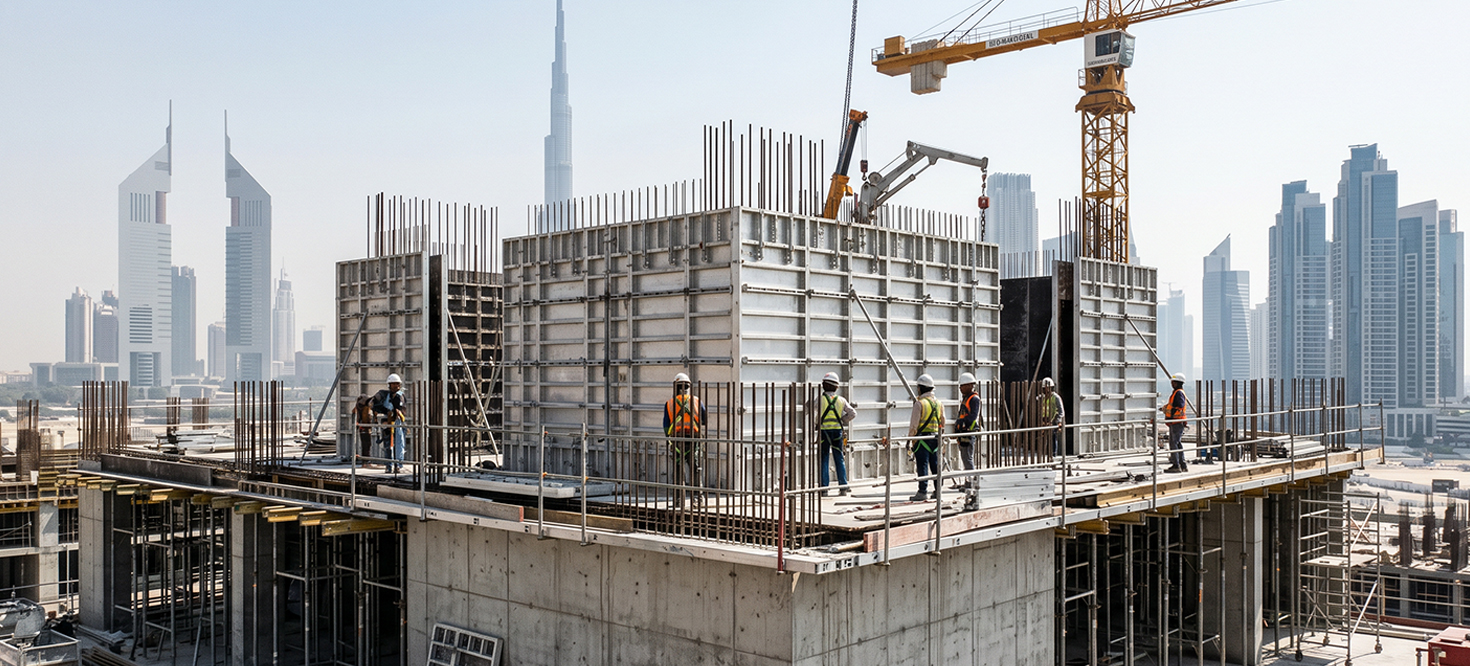
At the heart of this shift lies a clear trend: the evolution of aluminium formwork systems toward wider, single-piece panels. These systems are redefining how buildings are cast, floors are cycled, and large projects are delivered at scale.
This blog explains how aluminium formwork systems are evolving in 2026, why wider single-piece panels are becoming the new standard, and how they are enabling faster, more predictable construction outcomes.
1. Why Traditional Formwork Systems Are Struggling to Keep Up
Fragmentation Slows Everything Down
Conventional formwork systems rely on:
- Multiple narrow panels
- Extensive joining hardware
- High on-site assembly effort
- Frequent alignment corrections
While functional, these systems introduce:
- Longer erection and dismantling times
- Higher labor dependency
- Greater chances of misalignment
- Increased wear and maintenance
As projects scale up in size and repetition, these inefficiencies multiply rapidly.
2. The Shift Toward Systemized Aluminium Formwork
From Components to Complete Systems
Modern aluminium formwork in 2026 is designed as a complete construction system, not a collection of parts.
Systemized aluminium formwork focuses on:
- Standardized panel dimensions
- Repeatable assembly logic
- Integrated accessories
- Predictable load behavior
Wider, single-piece panels are a natural outcome of this system-driven approach.
3. Why Wider Panels Change the Game
Coverage, Speed, and Stability in One Move
Wider aluminium formwork panels, often up to 600 mm in width, provide:
- Larger coverage per panel
- Fewer joints and fasteners
- Faster installation per square meter
- Improved structural rigidity
Each panel replaces multiple narrower sections, simplifying every stage of the formwork cycle.
4. Single-Piece Panels: Eliminating the Weakest Link
Joints Are the Biggest Source of Delay and Defect
Every joint in a formwork system:
- Requires alignment
- Needs fastening
- Is a potential leakage point
- Introduces wear over time
Single-piece aluminium panels eliminate internal joints, resulting in:
- Faster erection
- Cleaner concrete finish
- Reduced maintenance
- More predictable performance
This is especially valuable in repetitive, high-rise, and mass housing projects.
5. Faster Floor Cycles and Predictable Timelines
Time Savings That Compound Across Floors
Wider, single-piece panels reduce:
- Panel count per floor
- Installation steps
- Adjustment time
- Stripping and reinstallation effort
Even small reductions in daily cycle time can:
- Shorten overall project duration
- Reduce financing costs
- Improve project cash flow
For large developments, this translates into significant economic advantage.
6. Improved Concrete Quality and Surface Finish
Quality Gains Without Extra Effort
Fewer joints result in:
- Minimal joint lines
- Reduced slurry leakage
- Uniform pressure distribution
This delivers:
- Better surface finish
- Reduced plastering and patchwork
- Improved dimensional accuracy
Quality improvements at the casting stage reduce downstream finishing costs and delays.
7. Reduced Labor Dependency in a Tight Market
Simpler Systems Need Fewer Skilled Hands
Construction markets globally are facing:
- Skilled labor shortages
- Rising labor costs
- High workforce turnover
Wider, systemized aluminium formwork reduces:
- Skill sensitivity
- Manual complexity
- On-site decision-making
Standardization makes training easier and execution more consistent.
8. Structural Performance and Safety Advantages
Predictable Load Behavior Matters
Single-piece aluminium panels offer:
- Uniform load transfer
- Reduced deflection
- Higher resistance to deformation
This improves:
- Safety during concrete pouring
- Stability under repetitive cycles
- Confidence in structural behavior
Predictability reduces risk, which is critical on large and fast-moving sites.
9. Manufacturing Capability Behind Modern Formwork Systems
Not All Aluminium Panels Are Equal
Producing wide, single-piece aluminium formwork panels requires:
- High-capacity extrusion presses
- Advanced die design
- Tight tolerance control
- Consistent billet quality
Manufacturing capability directly determines:
- Panel flatness
- Dimensional consistency
- Long-term durability
System performance on-site starts at the extrusion press.
10. Durability and Reuse Across Project Lifecycles
Built for Hundreds of Cycles
Modern aluminium formwork systems are designed for:
- High reuse life
- Minimal deformation
- Resistance to corrosion and impact
Wider panels reduce stress concentration at joints, improving:
- Long-term dimensional stability
- Asset life for contractors
- Cost per use over time
Durability turns formwork from a cost into a strategic asset.
11. Alignment with Modular and Industrialized Construction
Supporting the Future of Building
Wider, standardized aluminium formwork systems align well with:
- Modular construction
- Precast hybrid systems
- Industrialized building methods
Consistency and repeatability are essential for these approaches, making advanced aluminium formwork a natural fit.
12. What Developers and EPCs Expect in 2026
By 2026, decision-makers expect aluminium formwork systems to deliver:
- Faster construction cycles
- Consistent surface quality
- Lower labor dependency
- High durability and reuse
- Predictable project outcomes
Wider, single-piece panels meet these expectations more effectively than traditional alternatives.
Conclusion: Aluminium Formwork Systems Are Being Redefined
Aluminium formwork systems in 2026 are no longer judged by weight or cost alone. They are evaluated on speed, predictability, and system efficiency.
Wider, single-piece aluminium panels represent a clear step forward, simplifying execution, improving quality, and accelerating project delivery.
As construction timelines tighten and scale increases, formwork systems must evolve. Wider aluminium panels are setting the new standard.
Related Posts


