
Feb 15 2026
/
Why 600 mm Wide Aluminium Profiles Are Transforming Formwork and Infrastructure Projects
Introduction: A Structural Shift in Aluminium Formwork Engineering
The global construction and infrastructure industry is evolving rapidly. Large-scale housing projects, metro rail systems, bridges, renewable energy parks, industrial facilities, and smart city developments demand faster execution, higher structural integrity, reduced labor dependency, and long-term durability.
In this transformation, aluminium has emerged as a strategic material. More specifically, 600 mm wide aluminium profiles are redefining how modern formwork systems and infrastructure components are engineered and deployed.
What was once considered a niche capability has now become a competitive differentiator. Wider aluminium profiles reduce joints, increase structural strength, accelerate construction timelines, and improve lifecycle performance.
At the forefront of this technological advancement is National Industries, equipped with India’s largest 86 MN extrusion press capable of manufacturing aluminium profiles up to 600 mm width. This capability is not just about size. It represents engineering precision, structural optimization, and future-ready manufacturing.
Explore advanced extrusion capabilities at
www.nationalindustries.world
This article provides a comprehensive, technical, and strategic guide to understanding why 600 mm wide aluminium profiles are transforming aluminium formwork systems and infrastructure projects globally.
The Growing Demand for Large Aluminium Profiles in 2026
Infrastructure Scale Is Expanding
Governments and private developers across India, the Middle East, Europe, and North America are investing in:
- Mass housing and urban redevelopment
- Metro and high-speed rail projects
- Bridges and elevated corridors
- Industrial warehouses and logistics parks
- Renewable energy installations
These projects require structural systems that are:
- Lightweight yet strong
- Corrosion-resistant
- Easy to install
- Reusable and sustainable
- Scalable across large sites
Traditional steel-based systems are increasingly being replaced or supplemented with aluminium extrusion solutions due to their superior strength-to-weight ratio and reusability.
Why Profile Width Matters More Than Ever
Conventional aluminium profiles often range between 200 mm and 400 mm width. While suitable for smaller applications, these sizes create:
- More joints
- Increased welding
- Higher assembly time
- Greater structural stress concentration
600 mm wide aluminium profiles eliminate many of these limitations by offering:
- Larger surface coverage
- Higher load-bearing capacity
- Reduced structural segmentation
- Improved dimensional consistency
This is why wide aluminium extrusion technology is becoming central to next-generation construction engineering.
Understanding 600 mm Wide Aluminium Profiles
What Defines a 600 mm Aluminium Profile?
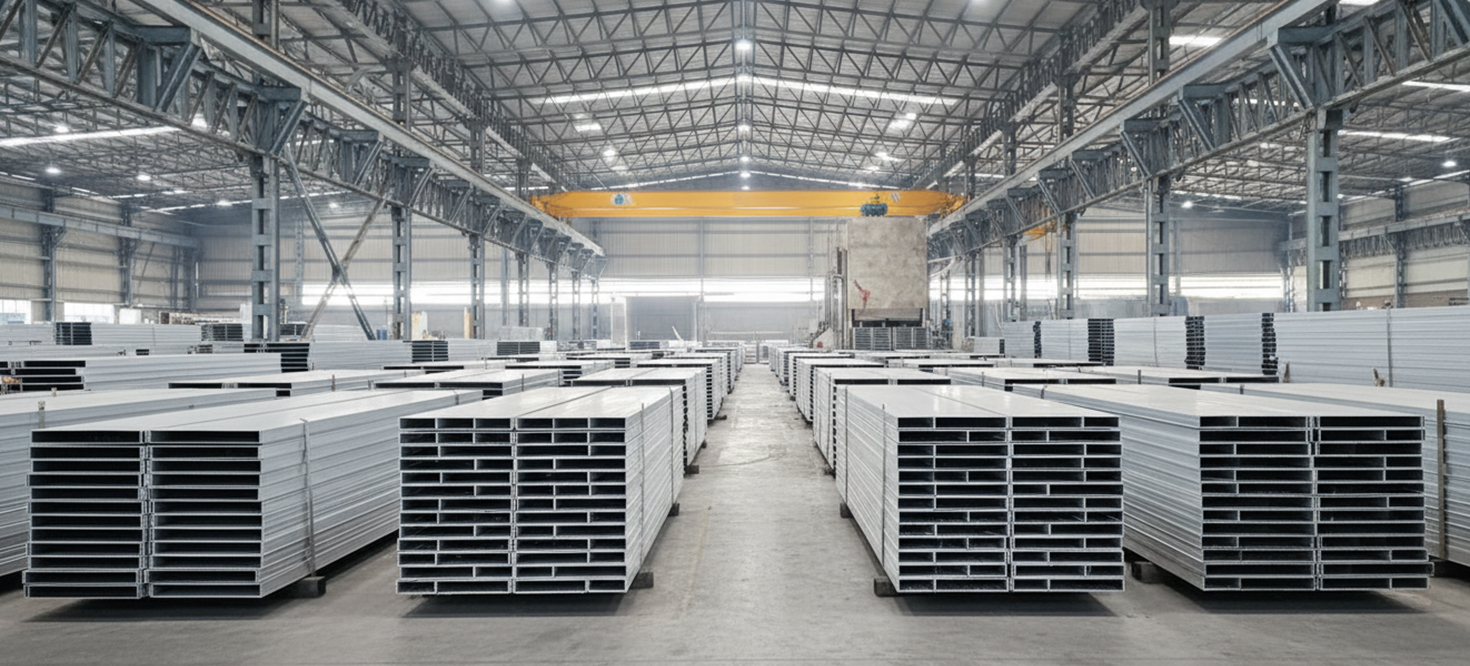
A 600 mm wide aluminium profile refers to a single extruded section with a cross-sectional width up to 600 millimeters. These can be:
- Solid structural sections
- Hollow multi-cavity profiles
- Reinforced panel designs
- Custom-engineered ribbed systems
Producing such wide profiles requires:
- High-tonnage extrusion presses
- Advanced die engineering
- Uniform metal flow control
- Precision temperature management
Only manufacturers with advanced infrastructure, such as an 86 MN extrusion press, can consistently produce 600 mm profiles with structural accuracy.
How 600 mm Wide Profiles Transform Aluminium Formwork Systems
Reduced Number of Joints
One of the biggest advantages of wide aluminium formwork profiles is joint reduction.
Fewer joints mean:
- Less welding and fastening
- Reduced risk of misalignment
- Improved structural strength
- Lower labor cost
In large residential tower projects, eliminating even 15–20 percent of panel joints can significantly reduce installation time.
Improved Load Distribution
Wider profiles distribute load more evenly across the panel surface.
This results in:
- Reduced deflection
- Better concrete finish
- Increased panel life cycles
- Higher structural reliability
For repetitive construction such as mass housing projects, durability and consistency are critical.
Faster Construction Cycles
Modern infrastructure projects operate under strict timelines. 600 mm aluminium formwork panels enable:
- Faster assembly
- Reduced handling time
- Improved alignment
- Quicker dismantling
The result is shorter project cycles and higher productivity per team.
Enhanced Reusability
High-strength, wide aluminium formwork panels can withstand hundreds of reuse cycles, making them cost-effective in long-term projects.
National Industries’ ability to manufacture up to 600 mm wide profiles supports durable, reusable aluminium formwork systems aligned with large-scale construction demands.
Structural Strength and Engineering Advantages
Thick-Wall Capability
600 mm wide aluminium profiles are often designed with thicker wall sections for:
- High load-bearing applications
- Elevated slab support
- Bridge and platform construction
- Industrial staging systems
High-capacity extrusion presses ensure metal flow stability even in thick cross-sections.
Complex Hollow Designs
Advanced die engineering enables production of:
- Multi-void hollow sections
- Rib-reinforced panels
- Integrated stiffeners
- Optimized cross-sections
This improves:
- Weight optimization
- Structural rigidity
- Material efficiency
Modern extrusion simulation software ensures these wide profiles maintain dimensional accuracy throughout production.
Infrastructure Applications Beyond Formwork
600 mm wide aluminium profiles are not limited to formwork systems. Their structural benefits extend across multiple industries.
Bridge and Elevated Structures
Wide aluminium extrusions support:
- Pedestrian bridge decks
- Walkway systems
- Platform panels
- Structural support beams
Corrosion resistance makes aluminium ideal for coastal and high-humidity environments.
Renewable Energy Installations
Solar and wind projects require:
- Wide mounting rails
- Structural support frames
- Modular assembly components
Large profiles reduce installation complexity and improve stability in high-wind zones.
Metro and Railway Projects
Railway infrastructure demands:
- Lightweight yet strong materials
- Precision alignment
- Long-term durability
Wide aluminium profiles contribute to structural components in stations, platforms, and support frameworks.
Advanced Extrusion Technology Enabling 600 mm Profiles
Role of the 86 MN Extrusion Press
Extruding 600 mm wide profiles requires:
- Massive extrusion force
- Uniform billet heating
- Precision die alignment
- Controlled cooling systems
An 86 MN extrusion press delivers the necessary pressure to maintain:
- Consistent metal flow
- Balanced structural integrity
- Surface finish quality
National Industries’ 86 MN press allows production of wide hollow profiles up to 550 mm and solid profiles up to 600 mm, positioning the company among the leaders in large-profile aluminium extrusion manufacturing.
Digital Monitoring and Automation
Modern extrusion lines integrate:
- Real-time process monitoring
- Automated billet loading
- AI-driven pressure control
- Predictive maintenance systems
These technologies reduce process variation and improve consistency across batches.
Sustainability Benefits of Wide Aluminium Profiles
Reduced Material Usage
By eliminating multiple smaller profiles and joints, 600 mm wide extrusions:
- Optimize material usage
- Reduce fabrication waste
- Lower overall project carbon footprint
Recyclability and Lifecycle Performance
Aluminium is infinitely recyclable without property degradation. Wide formwork panels support:
- Long service life
- High reuse cycles
- End-of-life recyclability
Sustainable infrastructure development increasingly favors aluminium extrusion systems.
Economic Advantages for Developers and Contractors
Lower Labor Costs
Fewer joints and larger panel sizes mean:
- Reduced assembly time
- Lower skilled labor dependency
- Faster project turnover
Reduced Maintenance
Wider profiles offer:
- Fewer connection points
- Less wear and tear
- Improved structural longevity
Faster ROI
Shorter construction timelines lead to:
- Earlier project completion
- Faster revenue generation
- Improved investment efficiency
For infrastructure developers, wide aluminium profiles are not just engineering upgrades. They are financial advantages.
Global Aluminium Extrusion Trends Supporting 600 mm Profiles
Mega Construction Projects
Smart city initiatives and urban redevelopment projects demand:
- High-performance materials
- Rapid deployment systems
- Long-term structural reliability
Modular Construction Growth
Prefabricated construction systems benefit from:
- Wide structural panels
- Precision extrusions
- Reduced on-site assembly
Increased Infrastructure Spending
Governments globally are allocating higher budgets to:
- Transportation networks
- Renewable energy infrastructure
- Affordable housing
Wide aluminium extrusion technology aligns directly with these global investment trends.
Quality Control and Precision Engineering
Manufacturing 600 mm wide aluminium profiles requires strict quality systems.
Key checks include:
- Alloy composition testing
- Dimensional accuracy measurement
- Surface finish inspection
- Load-bearing strength testing
- Microstructural evaluation
Automated quality control systems ensure repeatability at scale.
National Industries integrates quality control at every stage, from billet casting to final extrusion inspection.
Why National Industries Is Positioned for Wide Profile Leadership
National Industries combines:
- India’s largest 86 MN extrusion press
- Advanced billet casting capabilities
- Precision die engineering
- Automation-driven production systems
- Export-ready infrastructure
This enables delivery of:
- 600 mm wide aluminium profiles
- Heavy-duty structural extrusions
- Custom infrastructure solutions
- High-performance aluminium formwork components
Explore more at
www.nationalindustries.world
The Future Outlook: Wider Profiles, Smarter Infrastructure
By 2030, aluminium extrusion will increasingly support:
- Carbon-neutral construction
- Smart infrastructure systems
- Lightweight transport networks
- Sustainable energy frameworks
600 mm wide aluminium profiles represent a step toward:
- Reduced structural complexity
- Improved engineering efficiency
- Faster infrastructure deployment
Manufacturers investing in high-capacity extrusion technology today will lead the future of infrastructure manufacturing.
Conclusion: A Structural Revolution in Aluminium Engineering
600 mm wide aluminium profiles are transforming formwork and infrastructure projects by delivering:
- Greater structural strength
- Reduced joint dependency
- Faster installation cycles
- Improved durability
- Enhanced sustainability
With advanced extrusion technology such as the 86 MN press, National Industries is redefining aluminium profile manufacturing standards in India and global markets.
As construction and infrastructure demands continue to grow in scale and complexity, wide aluminium extrusion capability will remain a decisive competitive advantage.
National Industries stands prepared to engineer the future of infrastructure with precision, scale, and strength.
Related Posts


