
Mar 05 2026
/
From Billet to Profile: A Complete Guide to Modern Aluminium Extrusion Processes
Introduction: Understanding the Full Journey of Aluminium Extrusion
Aluminium extrusion is one of the most strategic and versatile manufacturing processes in global industry today. From high-rise construction systems and aluminium formwork to electric vehicle components, solar mounting structures, railway profiles, and industrial machinery frameworks, aluminium extrusions are shaping the future of modern infrastructure.
However, what many buyers and even industry professionals often overlook is the complete journey of aluminium, from molten metal to billet, from billet to profile, and from profile to engineered solution.
In 2026, aluminium extrusion is no longer just about pushing metal through a die. It is a highly controlled, technology-driven, quality-focused process that integrates metallurgy, automation, engineering design, and sustainability practices.
This detailed guide explains the modern aluminium extrusion process step-by-step, covering:
- Billet casting and alloy preparation
- Die design and manufacturing
- High-capacity extrusion press technology
- Cooling, stretching, and heat treatment
- Surface finishing and fabrication
- Quality control and inspection
- Sustainability integration
- Latest aluminium industry innovations
It also explains how forward-looking manufacturers like National Industries are aligning with these global trends to deliver precision aluminium extrusion solutions.
For detailed capabilities and product solutions, visit
www.nationalindustries.world
Stage 1: Raw Material Selection and Aluminium Alloy Preparation
Why Alloy Selection Matters
Every aluminium extrusion begins with the correct alloy composition. Aluminium alloys determine:
- Mechanical strength
- Corrosion resistance
- Weldability
- Formability
- Thermal and electrical conductivity
In industrial extrusion applications, commonly used alloys include:
- 6000 series (Al-Mg-Si alloys) for structural and architectural applications
- 7000 series for high-strength engineering requirements
- Custom alloys for specialized industrial performance
Modern aluminium extrusion manufacturers focus heavily on precise alloy chemistry control, as even small variations can impact final profile performance.
Modern Trend: Alloy Customization
By 2026, global OEMs increasingly demand application-specific alloy compositions. Manufacturers must offer:
- Consistent metallurgical control
- Customized alloy variants
- Traceability documentation
- International standard compliance
This is where integrated billet casting facilities become critical.
Stage 2: Billet Casting – The Foundation of Quality Extrusion
What Is an Aluminium Billet?
An aluminium billet is a cylindrical log of aluminium alloy that serves as the raw material for extrusion. The quality of the billet directly influences:
- Surface finish
- Internal structural integrity
- Dimensional stability
- Mechanical performance
Modern Billet Casting Process
The typical steps include:
- Melting aluminium ingots or recycled material in controlled furnaces
- Alloying with precise chemical additions
- Degassing to remove hydrogen and impurities
- Filtration to eliminate inclusions
- Direct Chill (DC) casting into cylindrical billets
- Homogenization heat treatment
Why Homogenization Is Important
Homogenization ensures:
- Uniform microstructure
- Improved extrusion performance
- Reduced cracking or tearing
- Better surface finish
Latest Innovation: Advanced Metallurgical Control
Modern billet casting facilities now incorporate:
- Automated temperature monitoring
- Real-time composition analysis
- AI-assisted melt correction systems
- Energy-efficient furnaces
Manufacturers like National Industries, with integrated capabilities, strengthen process control from billet to finished profile, ensuring reliability for high-demand applications.
Stage 3: Die Design and Engineering – Where Precision Begins
What Is an Extrusion Die?
An extrusion die is a specialized tool that shapes aluminium as it passes through under high pressure. The die determines:
- Profile shape
- Wall thickness
- Hollow or solid section design
- Dimensional accuracy
Types of Extrusion Dies
- Solid dies for simple shapes
- Hollow dies for complex profiles
- Multi-void dies for structural sections
- Wide-profile dies for large industrial applications
Modern Trend: Simulation-Based Die Design
In 2026, die development uses:
- Flow simulation software
- Thermal modeling
- Stress distribution analysis
- Metal flow optimization
AI-driven simulation reduces trial runs and ensures first-time-right production, saving cost and time.
For companies serving infrastructure, renewable energy, and industrial sectors, advanced die engineering is a core competitive advantage.
Stage 4: Billet Heating and Preparation
Before extrusion, billets are heated to a specific temperature range, typically between 400°C and 500°C depending on the alloy.
Why Temperature Control Is Critical
If the billet is:
- Too cold → high extrusion force, risk of cracking
- Too hot → surface defects, loss of mechanical strength
Modern extrusion lines use:
- Induction billet heaters
- Automated temperature control systems
- Infrared sensors for accuracy
Precision in billet heating ensures smooth metal flow and consistent profile quality.
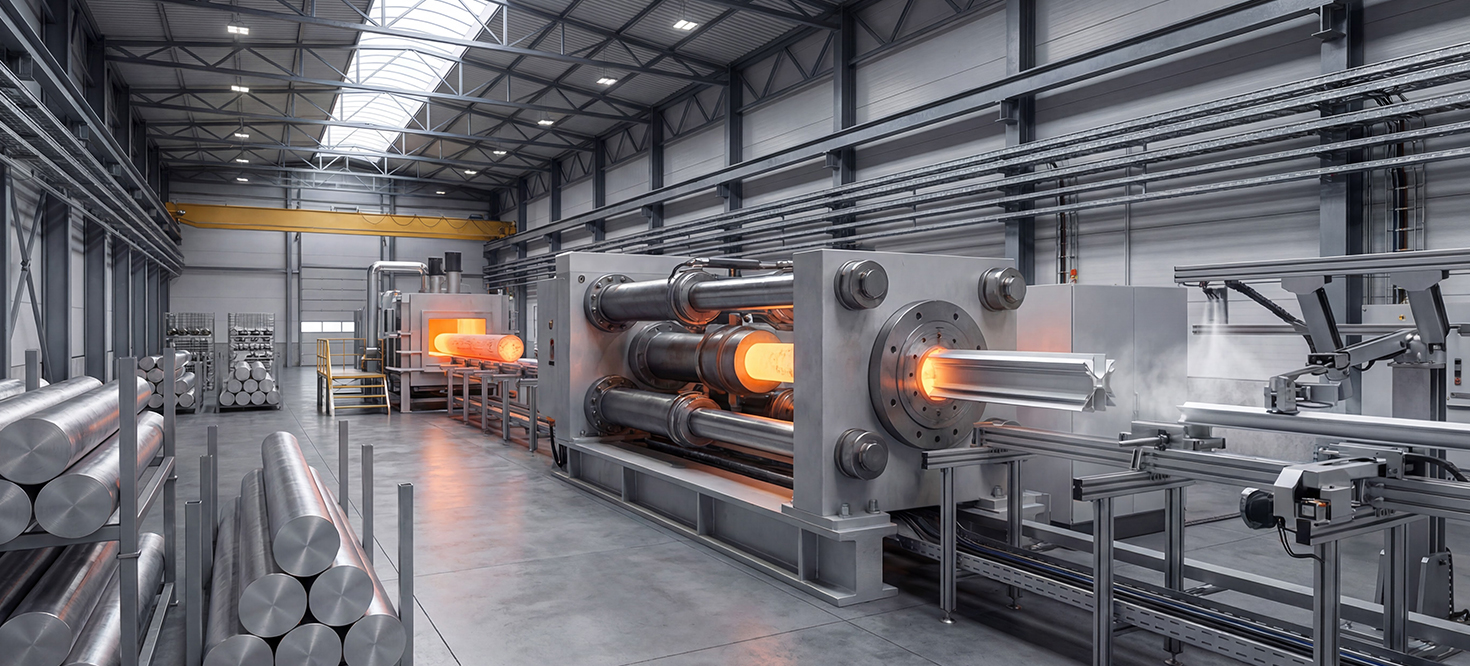
Stage 5: The Extrusion Process – From Billet to Profile
How Aluminium Extrusion Works
- The heated billet is placed into the extrusion container.
- A hydraulic ram applies pressure.
- Aluminium is forced through the die opening.
- The shaped aluminium emerges as a continuous profile.
Direct vs Indirect Extrusion
Direct extrusion is the most common method, where the billet and ram move in the same direction.
Indirect extrusion involves stationary billet movement and is used for specific high-precision applications.
Advanced Press Technology in 2026
Modern extrusion presses are defined by:
- High tonnage capacity (including ultra-large presses)
- Automated container alignment
- Intelligent pressure control
- Energy-efficient hydraulic systems
- Real-time production monitoring
High-capacity extrusion presses enable:
- Wide aluminium profiles
- Thick structural sections
- Heavy-duty industrial components
- Aluminium formwork panels up to 600 mm width
National Industries’ advanced press infrastructure supports large-scale, complex profile manufacturing, aligned with global demand for heavy-duty aluminium solutions.
Stage 6: Quenching, Cooling, and Profile Stabilization
After extrusion, aluminium profiles must be rapidly cooled.
Why Controlled Cooling Is Important
Proper quenching:
- Improves mechanical properties
- Controls grain structure
- Enhances strength performance
- Reduces internal stress
Modern systems use:
- Air quenching
- Water quenching
- Spray quenching systems
Temperature consistency ensures predictable strength levels across batches.
Stage 7: Stretching and Straightening
Extruded profiles may exhibit slight twisting or bowing. Stretching corrects these distortions.
The process:
- Clamps both ends of the profile
- Applies controlled tensile force
- Eliminates internal stresses
- Ensures straightness
This step is crucial for precision applications like curtain walls, solar rails, rail components, and industrial machinery frames.
Stage 8: Cutting and Aging (Heat Treatment)
Cutting
Profiles are cut to standard or customized lengths according to project requirements.
Artificial Aging
Aging ovens are used to enhance strength through precipitation hardening.
For 6000 series alloys, artificial aging:
- Increases tensile strength
- Improves hardness
- Stabilizes structural properties
Modern aging systems feature:
- Automated temperature control
- Energy-efficient heating
- Uniform air circulation
Stage 9: Surface Finishing – Functional and Aesthetic Enhancement
Surface finishing improves durability and corrosion resistance.
Common finishing methods include:
- Anodizing
- Powder coating
- Mill finish
- Mechanical polishing
2026 Trend: Performance-Driven Finishing
Industrial buyers demand:
- UV resistance
- Marine-grade corrosion resistance
- Architectural color consistency
- Anti-scratch coatings
Advanced surface treatment facilities ensure compliance with international standards.
Stage 10: Fabrication and Value-Added Services
Modern aluminium extrusion manufacturers increasingly offer fabrication services such as:
- CNC machining
- Drilling and punching
- Welding
- Assembly
- Custom finishing
This vertical integration reduces supply chain complexity for clients.
National Industries’ focus on delivering ready-to-install aluminium solutions enhances project efficiency for infrastructure and industrial clients.
Quality Control in Modern Aluminium Extrusion
Quality control is integrated at every stage:
- Chemical composition testing
- Spectrometer analysis
- Mechanical property testing
- Dimensional inspection
- Surface defect evaluation
- Load-bearing tests
Modern plants use:
- Digital inspection systems
- Automated measurement tools
- Traceability software
This ensures compliance with global quality standards.
Sustainability in Aluminium Extrusion
Aluminium is infinitely recyclable without loss of properties. In 2026, sustainability is central to extrusion strategy.
Modern extrusion plants focus on:
- Scrap recycling systems
- Energy-efficient presses
- Waste heat recovery
- Low-emission furnaces
- Reduced water consumption
Sustainable extrusion processes contribute to:
- Lower carbon footprint
- Green building certification
- ESG compliance
National Industries aligns with responsible manufacturing practices, supporting global sustainability goals.
Latest Aluminium Industry Innovations in 2026
AI-Driven Production Monitoring
Real-time analytics improve process efficiency and reduce downtime.
Smart Die Management
Predictive maintenance reduces tool wear failures.
High-Speed Extrusion Systems
Faster cycle times improve output capacity.
Large and Wide Profile Capability
Supporting infrastructure and modular construction.
Digital Supply Chain Integration
Faster order tracking and global coordination.
These innovations redefine industrial aluminium manufacturing.
Applications of Modern Aluminium Extrusions
By 2026, aluminium extrusion supports:
- Aluminium formwork systems
- Solar mounting structures
- Railway components
- EV battery enclosures
- Aerospace structural parts
- Industrial automation systems
- Architectural façade systems
Advanced press technology allows manufacturers to meet performance demands across these sectors.
Why the Complete “Billet to Profile” Control Matters
Manufacturers controlling the full value chain offer:
- Better quality consistency
- Faster development cycles
- Customized alloy solutions
- Reduced lead times
- Improved cost efficiency
National Industries’ integrated manufacturing approach strengthens its ability to deliver industrial-scale, precision-engineered aluminium extrusion solutions globally.
Choosing the Right Aluminium Extrusion Partner
In 2026, buyers evaluate extrusion partners based on:
- Press capacity
- Wide-profile capability
- In-house billet casting
- Advanced die engineering
- Automation and quality systems
- Sustainability commitment
- Export readiness
Advanced infrastructure combined with engineering depth defines global leaders in aluminium extrusion.
Conclusion: The Future of Aluminium Extrusion Is Integrated, Intelligent, and Scalable
The journey from billet to profile is no longer a simple mechanical process. It is a highly engineered manufacturing ecosystem powered by:
- Advanced press technology
- Metallurgical precision
- Automation and AI
- Sustainability integration
- Application-specific engineering
As industries demand larger structures, lighter materials, and more efficient solutions, aluminium extrusion continues to expand its global relevance.
Manufacturers that control the complete value chain and invest in next-generation extrusion infrastructure will define the future of industrial manufacturing.
National Industries stands aligned with these global aluminium extrusion trends, delivering precision, scale, and reliability for infrastructure and industrial projects worldwide.
Related Posts


